




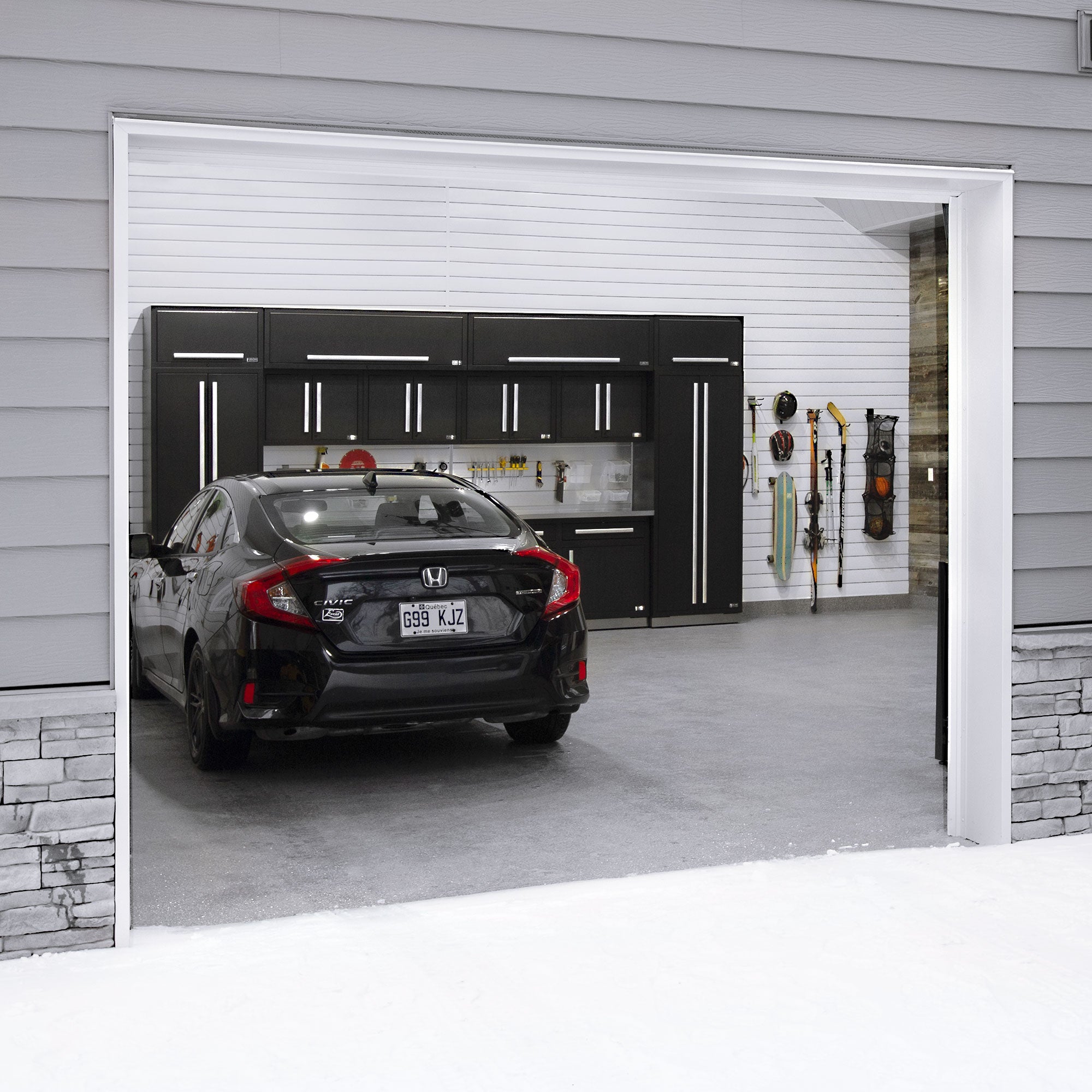

18-gauge steel is a strong foundation for garage cabinetry, but steel gauge alone does not determine cabinet quality. The type of steel, how the cabinet is constructed, how individual components are reinforced, and the hardware supporting them all affect how the finished cabinet performs.
When comparing steel garage cabinets, gauge is one of the first specifications you are likely to see.
18-gauge. 20-gauge. 24-gauge.
Those numbers tell you how thick the steel is, but they do not tell you everything about the cabinet made from it.
At Proslat, galvannealed steel is the base material used across our steel cabinets and CORE toolboxes, with different gauges and construction methods selected according to the job each component needs to perform.
For our garage cabinets, the primary structure is built from 18-gauge galvannealed steel. That gives us a substantial material to start with, but the real strength of the finished cabinet comes from how that steel is formed, welded, reinforced and supported.
What Does Steel Gauge Actually Tell You?
Steel gauge describes the thickness of sheet metal. The lower the gauge number, the thicker the steel.
For common garage cabinet gauges:
| Steel gauge | Approximate thickness |
|---|---|
| 18-gauge | 0.0478 in. / 1.21 mm |
| 20-gauge | 0.0359 in. / 0.91 mm |
| 24-gauge | 0.0239 in. / 0.61 mm |
Thicker steel generally provides greater rigidity and resistance to flexing, bending and denting.
So gauge is absolutely worth considering.
But it does not tell you what type of steel is underneath the finish, how the cabinet is assembled, how its doors and drawer fronts are reinforced, what its shelves and drawers can support, or what hardware is carrying those loads.
That is why two cabinets advertised with the same steel gauge can still be very different products.
Not All Steel Is the Same
Gauge tells you how thick the steel is. It does not tell you what kind of steel you are getting.
Proslat uses galvannealed steel as the base material across our cabinets and steel toolboxes.
Galvannealed steel starts with zinc-coated steel and undergoes an additional heat-treatment process that creates a zinc-iron alloy coating bonded to the surface.
It is widely used in automotive manufacturing because it combines corrosion protection, weldability and a surface well suited to painted finishes.
For garage cabinetry, that gives us a strong starting material before the cabinet even reaches the finishing stage.
So when two manufacturers both advertise 18-gauge steel, the thickness may be comparable while the material underneath the finish may not be.
How Proslat Builds Strength Beyond Steel Gauge
The primary structure of Proslat garage cabinets uses 18-gauge galvannealed steel.
The cabinet boxes are also fully welded and incorporate our Quad Core corner construction, creating a reinforced four-point box structure at each cabinet corner.
The 18-gauge steel provides the material strength. The welding, bends and reinforced corners turn that material into a rigid finished structure designed to stay square and stable under load.
This is why the construction of the cabinet matters just as much as the material specification itself.
Why Dual-Wall Construction Matters
Not every part of a cabinet performs the same job, so looking only at one gauge number can miss important construction details.
Dual-wall cabinet doors
Proslat cabinet doors use dual-wall steel construction rather than relying on a single sheet of steel.
The two-wall design creates a reinforced, rigid door with a substantial finished construction.
On our tall cabinets, a left-and-right pair of doors weighs approximately 80 lb., which gives you a sense of just how substantial that construction is.
Those doors are supported by continuous commercial-grade hinges, distributing support along the height of the door rather than concentrating it at only a few hinge points.
The result is a heavy, reinforced door system designed as a complete assembly, not simply a sheet of steel attached to a cabinet.
Dual-wall drawer fronts
Proslat drawer fronts are also built using a dual-wall design.
The structural inner drawer panel is covered by a separate steel facade, creating a more reinforced and rigid drawer front designed to stand up to repeated use in a garage environment.
That construction also provides another long-term advantage: the exterior facade can be replaced independently if it is ever damaged or needs to be serviced, without replacing the entire drawer.
Those are the kinds of details that a steel gauge specification alone cannot show you.
Load Capacity Depends on the Complete System
Steel thickness contributes to strength, but the amount of weight a cabinet component can support depends on everything working together.
A drawer, for example, relies on:
- The drawer structure
- The cabinet supporting it
- How the slides are mounted
- The strength of the slides themselves
Proslat cabinet drawers use commercial-grade Fulterer soft-close roller-bearing slides rated for up to 400 lb. per drawer.
That published load capacity tells you what the finished drawer system has actually been designed to support.
The same principle applies to shelves.
Shelf performance depends on:
- How the steel is formed
- How the shelf is reinforced
- The width and span of the shelf
- How it mounts to the cabinet
- The structure supporting it
Proslat cabinet shelves are rated to support up to 200 lb.
When comparing garage cabinets, published component capacities provide much more useful information than trying to estimate performance from steel gauge alone.
Why Different Products Use Different Steel Gauges
There is no single steel gauge that makes sense for every storage product.
Our CORE toolboxes are a good example.
A toolbox may carry dense collections of sockets, wrenches, power tools and other equipment in a relatively compact area. Those loads create different structural demands than a tall storage cabinet.
CORE toolboxes therefore use a mix of 14-gauge and 16-gauge galvannealed steel, with heavier material used where additional structural strength is required.
That does not mean every garage cabinet should simply be built from the thickest steel possible.
It means the material should be selected for the job the product and its individual components are designed to perform.
Corrosion Resistance Is More Than Steel Gauge
Steel gauge also tells you very little about corrosion resistance.
A thicker piece of steel can still corrode if it is not properly protected.
Proslat starts with galvannealed steel, giving the material a protective base before the visible finish is applied.
The steel then receives a zirconium pretreatment before powder coating, creating multiple stages of corrosion protection rather than relying solely on the outer powder coat.
That is particularly relevant in garages where cabinetry may be exposed to humidity, temperature changes, wet vehicles, snow and road salt.
For a deeper look at this topic, see What Makes a Garage Cabinet Resistant to Rust and Corrosion?
What Should You Compare Besides Steel Gauge?
When comparing steel garage cabinets, gauge belongs on the checklist, but it should not be the entire checklist.
Look at:
The base material
What type of steel is underneath the finish?
Cabinet construction
Is the cabinet fully welded or assembled from separate panels?
How are the corners reinforced?
Doors and drawer fronts
Are they single-wall, dual-wall or otherwise reinforced?
Drawer capacity
What is the finished drawer system actually rated to support?
Shelf capacity
Does the manufacturer publish the load capacity of each shelf?
Hardware
What slides and hinges are being used?
Are replacement components available?
Corrosion protection
How is the steel protected before the visible finish is applied?
Warranty
Does the manufacturer stand behind the components that receive the most repeated use?
Proslat backs its cabinet drawer slides and hinges with a lifetime warranty.
So, Are 18-Gauge Garage Cabinets Better?
18-gauge steel is an excellent foundation for a high-quality garage cabinet.
It provides a substantial material with strong rigidity and resistance to deformation.
But a quality cabinet is the result of more than one material specification.
At Proslat, we start with galvannealed steel, use 18-gauge material in the primary cabinet structure, fully weld the cabinet boxes, reinforce the corners, use dual-wall construction in doors and drawer fronts, and pair that structure with commercial-grade hardware and published load capacities.
Different products may use different gauges when their structural demands change.
That is the important distinction.
The goal is not to use the lowest gauge number everywhere. It is to use the right steel, in the right place, with the right engineering around it.
So when comparing garage cabinets, ask more than:
“What gauge steel is it?”
Also ask:
What type of steel is it?
How is the cabinet constructed and reinforced?
How are the doors and drawer fronts built?
What are the drawers and shelves actually rated to hold?
What hardware is carrying those loads?
How is the steel protected against corrosion?
Those answers give you a much better picture of the cabinet you are buying.
Frequently Asked Questions
Is 18-gauge steel good for garage cabinets?
Yes. 18-gauge steel provides a strong and rigid foundation for garage cabinet construction. Overall quality also depends on the type of steel, structural design, reinforcement, hardware and published load capacities.
Are Proslat cabinets made from 18-gauge steel?
Proslat garage cabinets use 18-gauge galvannealed steel in the primary cabinet structure, combined with fully welded construction and reinforced components.
Is lower-gauge steel always better?
No. A lower gauge number means thicker steel, but the thickest possible material is not automatically the best choice for every component. Different products and components have different structural requirements.
Why does dual-wall construction matter?
Dual-wall construction creates a more reinforced and rigid finished component than relying on a single wall of steel. Proslat uses dual-wall construction in both cabinet doors and drawer fronts.
How heavy are Proslat cabinet doors?
A left-and-right pair of doors on Proslat tall cabinets weighs approximately 85 lb., reflecting the substantial dual-wall steel construction of the finished doors.
What is galvannealed steel?
Galvannealed steel is zinc-coated steel that undergoes an additional heat-treatment process to create a zinc-iron alloy coating. It is valued for corrosion protection, weldability and suitability for painted finishes.
What gauge steel are Proslat CORE toolboxes?
Proslat CORE toolboxes use a combination of 14-gauge and 16-gauge galvannealed steel, with the material selected according to the structural requirements of the product.
What should I compare besides steel gauge?
Look at the type of steel, cabinet construction, reinforcement, door and drawer construction, drawer and shelf capacities, hardware, corrosion protection, warranty and availability of replacement components.


Leave a comment
This site is protected by hCaptcha and the hCaptcha Privacy Policy and Terms of Service apply.